Fake Cartier vs Real: How to Spot the Difference
With Cartier, the whole story is on the dial. The Roman numerals, the sword-shaped blue hands, the railway-track minute ring, the hidden “Cartier” secret signature, and the blue sapphire cabochon on the crown — get these right and the watch reads as a Cartier from across a room. A cheap fake fails most of them; a flagship super clone reproduces nearly all. This guide walks every difference between a fake Cartier and a real one, model by model, and is honest about where a good super clone matches genuine and where it does not.

The Quick Answer
Forget weight and sweep tests — most Cartiers are dress watches, and many are quartz, so those tricks do not apply. With Cartier, you read the dial and the crown. On the dial, check the Roman numerals (correct Cartier font, even spacing), the sword-shaped blue hands, the railway-track minute ring, and — the classic tell — the secret signature, Cartier’s name hidden inside one of the numerals. On the crown, check the cabochon: a genuine Cartier uses a real synthetic-sapphire cabochon with depth and a correct blue, while a cheap fake uses flat, plastic-looking glass.
Here is how the three tiers line up across the checks that matter on a Cartier:
Why Cartier Is the Most Copied Jewellery Watch
Cartier occupies a different space from Rolex or Patek. It is as much a jeweller as a watchmaker, and its icons — the Santos (one of the first purpose-built wristwatches, from 1904), the Tank (1917, inspired by the Renault tanks of the First World War), the Ballon Bleu and the Panthère — are defined by design rather than by a complicated movement. That is precisely why they are so heavily replicated: the value lives in the shape, the Roman-numeral dial and the cabochon, not in a hand-finished caliber hidden behind the case.
It also explains why a good Cartier super clone can be so convincing. Where a Patek lives or dies on the movement a factory cannot copy at scale, a Cartier lives on surfaces a factory can reproduce — the dial printing, the case geometry, the blued hands, the sapphire cabochon. Get those right and you have captured most of what makes the watch a Cartier. The flip side is that cheap fakes are everywhere, because the design is so recognisable that a lazy copy still “reads” as a Cartier from a distance — which is exactly why knowing the real tells matters.
The Dial & the Secret Signature
The dial is where cheap fakes die. Cartier’s Roman numerals have a very specific typeface — the proportions, the serifs and the spacing are consistent across the whole lineup, and a cheap fake almost always gets the font subtly wrong: numerals too fat, too thin, or unevenly spaced around the dial. Look next at the railway-track (chemin de fer) minute ring, which should be fine and perfectly even; on a weak fake it is thick, blobby or irregular.
The famous tell is the secret signature. Since the early 2000s Cartier has hidden the word “Cartier” inside one of the Roman numerals — most often the “VII” or the “X” — printed so small you need magnification to see it. A cheap fake either omits it entirely or prints a crude, unreadable version. A flagship super clone reproduces it correctly, which is exactly why the secret signature, once a reliable authentication test, no longer separates the best clones from genuine — it only eliminates the cheap tier. The same goes for the sword-shaped blued-steel hands: they should be a clean, even blue with the correct taper, not a painted navy on a cheap build.
The Crown & the Cabochon
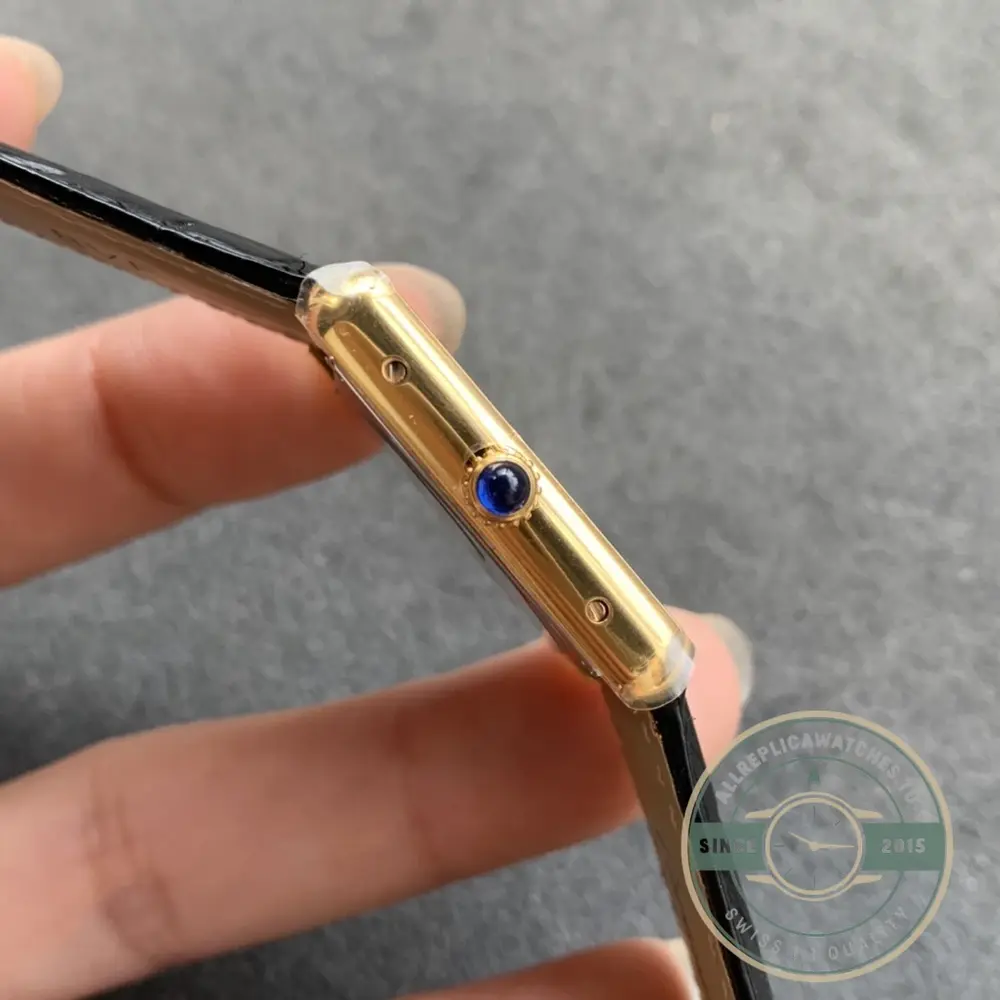
The crown is a signature Cartier detail and a superb tell. A genuine Cartier crown is set with a cabochon — a domed, polished synthetic sapphire (blue spinel on many references) with real depth and a rich, slightly purple-blue colour. Tilt it under light and the stone has dimension; it is not flat. A cheap fake uses a lump of blue glass or plastic that looks flat, too bright, or the wrong shade entirely, and often sits crookedly in the crown.
On a flagship super clone the cabochon is a proper synthetic sapphire, correctly coloured and seated, which is why the crown — like the dial — no longer gives the best clones away. Check the crown’s shape too: the fluting and the way it meets the case should be clean and symmetrical. Together with the dial, the cabochon is the fastest way to separate a cheap Cartier fake from a flagship build in a single glance.
Case, Screws & Bracelet
Cartier case finishing is clean and geometric, and this is where mid-tier fakes slip. On a Santos, the exposed screws on the bezel and bracelet are a defining feature — on a genuine watch and a flagship clone they are evenly finished and (on current models) part of the functional SmartLink and QuickSwitch systems, with correct slot alignment. On a cheap fake the screws are decorative, misaligned or crudely cut. On a Tank, the brushed and polished surfaces of the case meet in crisp lines, and the proportions of the rectangular case must be exact — a fake often gets the width-to-height ratio subtly wrong.
The bracelet and strap are the next test. A Cartier metal bracelet is solid and well-articulated with tight tolerances between links, while a cheap fake rattles and feels hollow. On leather-strap models, the strap is dense, cleanly stitched and correctly Cartier-signed on the buckle. These are details you can judge from good QC photos, which is why you should always ask for them before buying a Cartier super clone.
Movement & Caseback

Cartier is not a movement-first brand the way Patek is — many references are quartz, and the mechanical ones use solid but unexotic automatic calibers. So the movement is less of a dramatic tell than on a Patek, but it still matters. On a flagship super clone, mechanical models typically run a reliable automatic (a Miyota 9015-based caliber), while thin dress pieces use quartz, matching how Cartier itself builds the line. The key check is behaviour: a quartz model should tick in clean one-second steps, and an automatic should sweep smoothly — a mismatch between what the dial says and how the hand moves is a red flag.
The caseback is the other check. Cartier engravings — the reference, the “Cartier” signature, the hallmarks — should be crisp, correctly spaced and at the right depth. On a cheap fake they are shallow, uneven or wrongly positioned. On a flagship clone they are clean and correct. If a model should have a specific caseback layout and the one in front of you does not match, treat it as a warning.
Cartier Santos Fake vs Real
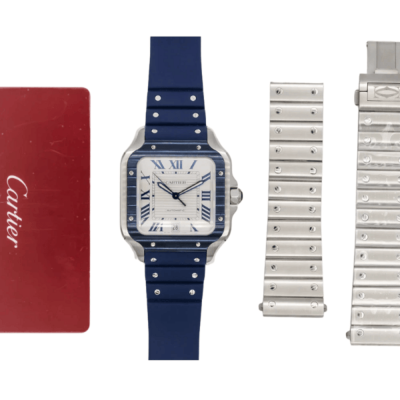
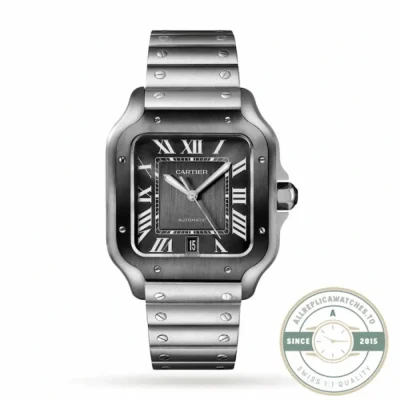
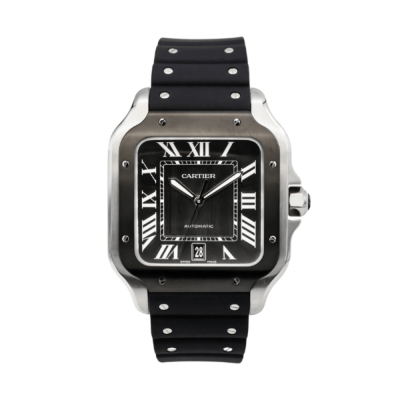
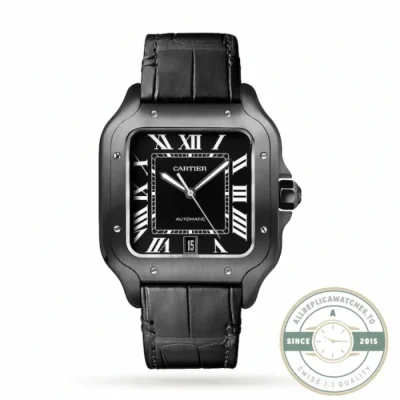
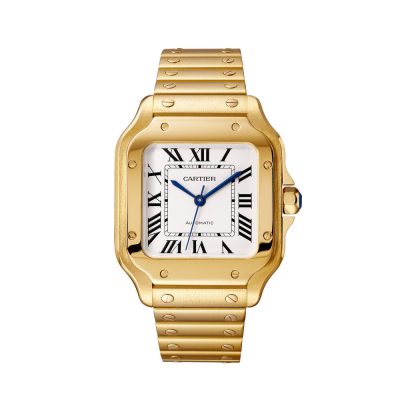
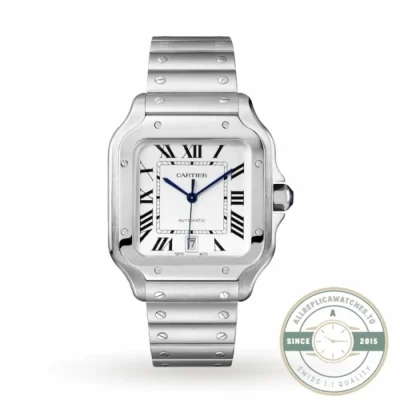
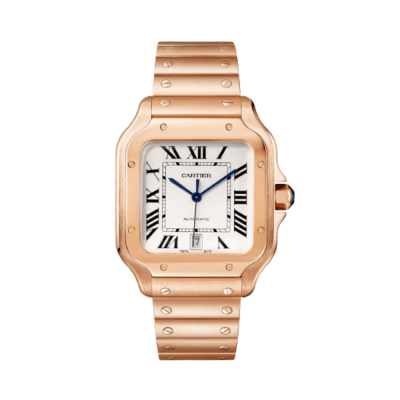
The Santos is the most replicated Cartier, so it is where factories have invested the most. On a Santos, focus on three things: the exposed screws (evenly finished, correctly aligned, and functional on current models), the SmartLink bracelet and QuickSwitch system (the bracelet should adjust and swap cleanly), and the dial with its Roman numerals and secret signature. A flagship Santos super clone nails all three; a cheap fake gives itself away on the screws and the bracelet feel alone. Browse the current range in the Santos collection.
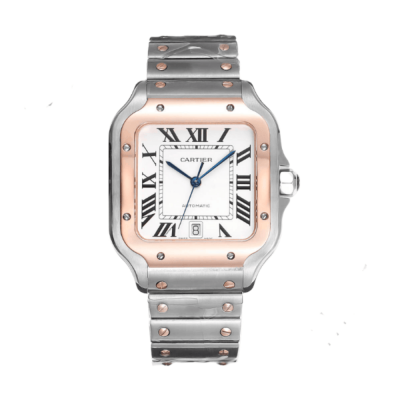
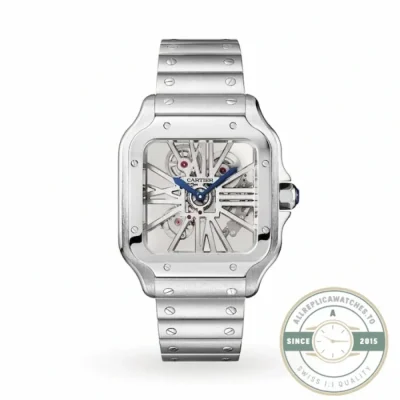

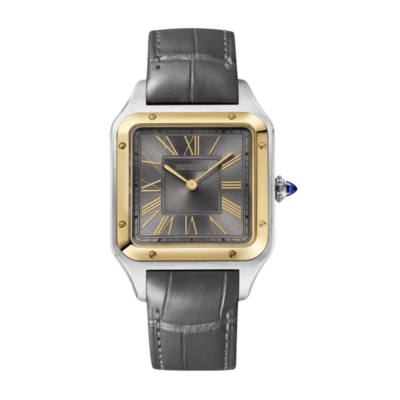
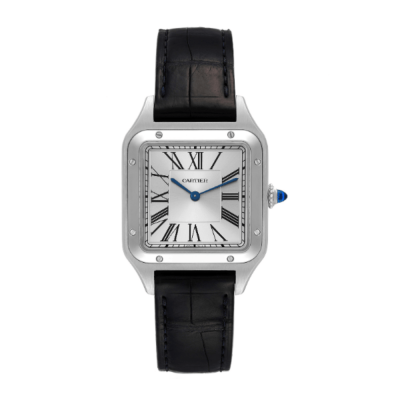
Tank & Ballon Bleu Fake vs Real
On a Tank, the giveaways are the case proportions and the Roman numeral dial. The rectangular case has an exact width-to-height ratio and clean brushed-to-polished transitions on the brancards (the vertical side bars); a fake often gets the proportions or the finishing subtly wrong. On a Ballon Bleu, the signature is the protected crown set into the side of the round case, with the cabochon nestled in its guard — the shape and finishing of that crown guard are a fast tell, along with the guilloché dial texture. Both models follow the same dial, cabochon and engraving rules as every Cartier. Explore the Tank and Ballon Bleu collections.
What No Cartier Fake Fully Passes
Two things separate every replica from a genuine Cartier, and an honest guide names them:
Everything else — the Roman numerals, the secret signature, the cabochon, the chemin de fer, the case and bracelet — a flagship super clone now reproduces convincingly. These two it does not, and we would rather say so than pretend otherwise.
Cheap Fake vs Flagship Super Clone
The takeaway of any Cartier fake-vs-real comparison is that “fake” is not one thing. A cheap fake gives itself away on the dial and the cabochon from across a table; a flagship super clone passes the dial, the crown, the case and the bracelet, and only magnification and paperwork place it as a replica. If you want the Santos, Tank or Ballon Bleu look — and you buy it honestly as a replica, not a genuine Cartier — the flagship super clone is the only tier worth your money. For the full breakdown of Cartier factories and models, read our best Cartier super clone guide.
Super Clone vs a Genuine Cartier
It is worth being clear about the trade. A genuine Santos, Tank or Ballon Bleu runs from a few thousand dollars into much more for gold and jewelled versions, backed by Cartier’s name, papers and boutique service. A flagship super clone gives you the Roman-numeral dial, the sapphire cabochon, the clean case and the bracelet for a fraction of that.
What you give up is the finest finishing under magnification, the papers and serials, and any resale value as a genuine Cartier. What you keep is the entire look and feel on the wrist — the instantly recognisable design that is the whole point of a Cartier. Because Cartier’s value is in its design rather than a hidden movement, a flagship super clone captures more of the genuine experience than it can on a movement-first brand, and buying it honestly as a replica is the sensible way to enjoy it. For the best factory and model picks, read our best Cartier super clone guide.
Frequently Asked Questions
How can you tell a fake Cartier?
Read the dial and the crown. Check the Roman numeral font and spacing, the fine railway-track minute ring, the hidden secret signature in a numeral, the sword-shaped blue hands, and the sapphire cabochon on the crown. Cheap fakes get these wrong; a flagship clone reproduces them.
What is the Cartier secret signature?
It is the word “Cartier” micro-printed inside one of the Roman numerals — usually the “VII” or the “X” — visible only under magnification. It has been used since the early 2000s as an authentication feature.
Is the cabochon on the crown a good tell?
Yes. A genuine Cartier cabochon is a domed synthetic sapphire with depth and a rich blue. A cheap fake uses flat blue glass or plastic. A flagship super clone uses a correct synthetic-sapphire cabochon.
Can a super clone Cartier fool a jeweller?
From the dial side, often yes. A watchmaker with a loupe inspecting the micro-engraving, or a boutique checking serials and papers, can identify it. The finest finishing and the records are the lines a replica cannot cross.
Which Cartier is most faked?
The Santos, Ballon Bleu, Tank and Panthère, by a wide margin — the most recognisable Cartier designs, so factories have invested the most R&D in copying them.
Are Cartier watches quartz or automatic?
Both. Many Cartier dress watches are quartz, while sportier and larger models are automatic. A good super clone matches the genuine: quartz where the real one is quartz, automatic where it is automatic.
Browse flagship Cartier super clones — correct dials, sapphire cabochons and clean case finishing, with QC photos on request.